

I had the pleasure of attending the 49th Annual Meeting of the European Radiation Research Society (ERRS 2025) in Brussels, Belgium, from 2 to 4 September 2025. This was a particularly meaningful trip for me. Not only was it my first visit to Brussels, a city full of history and significance, it was also a productive scientific gathering where I could present new resesrch data, reconnect with mentors, and learn about exciting ongoing research from experts from different parts of the world.
Sharing science
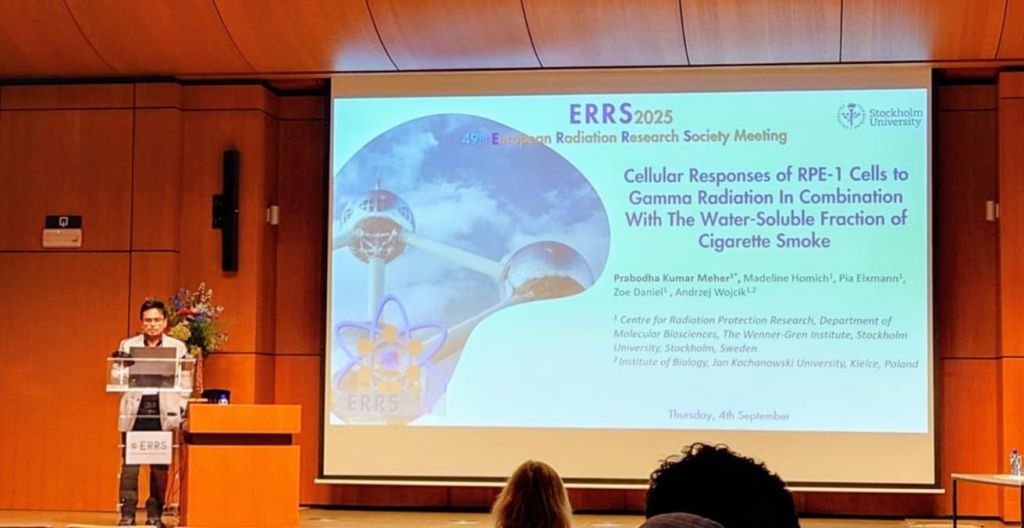
I gave an oral presentation titled “Cellular Responses of RPE-1 Cells to Gamma Radiation in Combination with the Water-Soluble Fraction of Cigarette Smoke.” This work builds on epidemiological observations that smokers exposed to ionizing radiation often have an increased lung cancer risk compared with non-smokers, seen for example in studies of atomic bomb survivors from Japan and in residential radon exposure scenarios. Our aim is to understand the cellular interactions between ionizing radiation and cigarette smoke components so we can better interpret those population signals in mechanistic terms.
My talk described experiments on RPE-1 cells exposed to gamma radiation combined with the water-soluble fraction of cigarette smoke, and I presented the key results from our research. This presentation prompted several thoughtful questions and a lively discussion with fellow researchers. Those exchanges were insightful.
Our research and collaboration
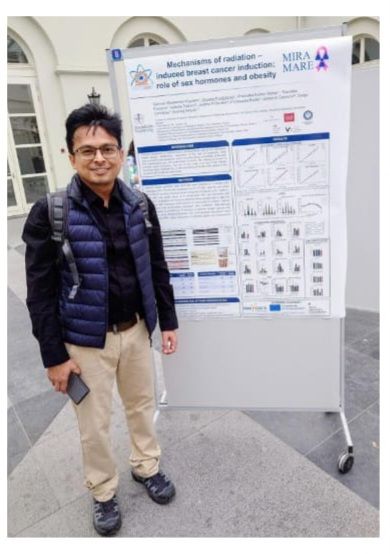
This radiation and smoke project was part of our effort in a European Commission funded RADONORM project. My current main project falls within another European Commission PIANOFORTE-funded MIRAMARE programme, where we focus on mechanisms of radiation-induced breast cancer and the roles of sex hormones and obesity. At ERRS I also co-presented a poster with my colleague Zuzana, who led the poster presentation for our MIRAMARE project. The poster allowed more extended one-on-one discussions and gave visiting researchers and scientists a chance to dive into our experimental detail.
I was glad to meet with collaborators from the recently concluded European Commission funded SINFONIA project as well. After the conference, Prof. Andrzej Wojcik, my PI, Zuzana and I traveled to Ghent to visit Prof. Anne Vral and Prof. Ans Baeyens in the Radiobiology, Department of Human Structure and Repair at Ghent University. We had very productive discussions with their team, including Lama Ramadan who is pursuing a PhD with them and was also part of our research team in SINFONIA project. Those conversations helped interpret some of our recent results and generated concrete ideas for follow-up tasks done.
Connections
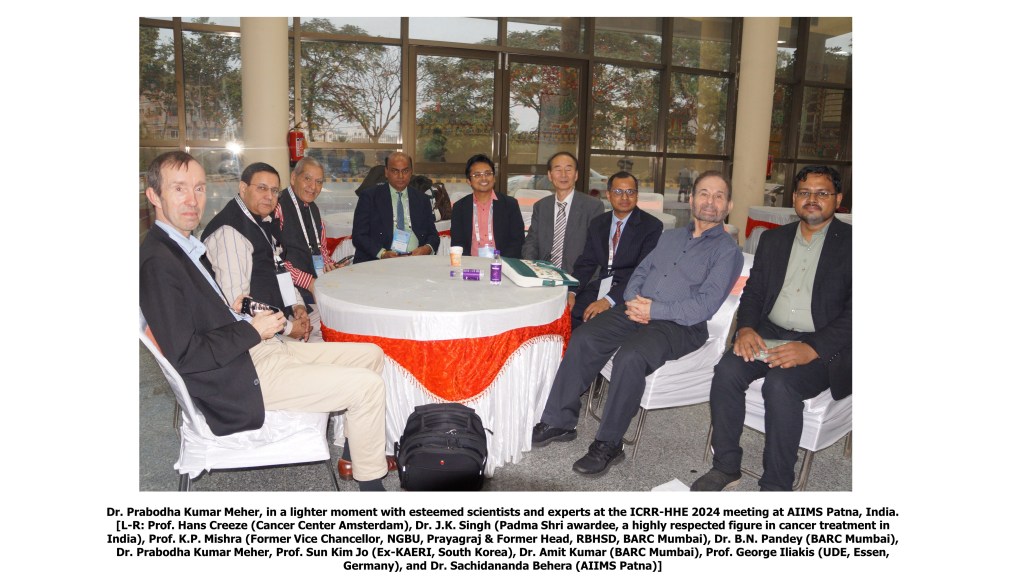
The meeting also gave me the chance to reconnect with my mentor from Germany, Prof. George Iliakis, which was both inspiring and nostalgic. Meeting my own mentor after a few years like this reminds me how formative mentorship is in shaping one’s scientific journey. I was equally pleased to meet Prof. Sarah Baatout, the organising chair of the conference, and to engage in some very fruitful scientific discussions with her. It was always a pleasure to meet Prof. Siamak Haghdoost,University of Caen Normandy, Caen, France. I also make new connections, including meeting Debojit Chaudhary from Yenepoya University, India, and several other people with whom I look forward to keeping in touch and exchanging ideas in the future.
Belgian stories
Exploring Brussels itself was a highlight. After the meeting, we visited the Atomium with Andrzej and Zuzana. Seeing that iconic structure in person was a memorable way to close the conference. I also enjoyed Belgian waffles, I heartily recommend the simple one with white sugar powder. I had hoped to try Belgian fries too, but I could not find a place that fried them in vegetable oil rather than beef fat, so that will remain on my list for next time.
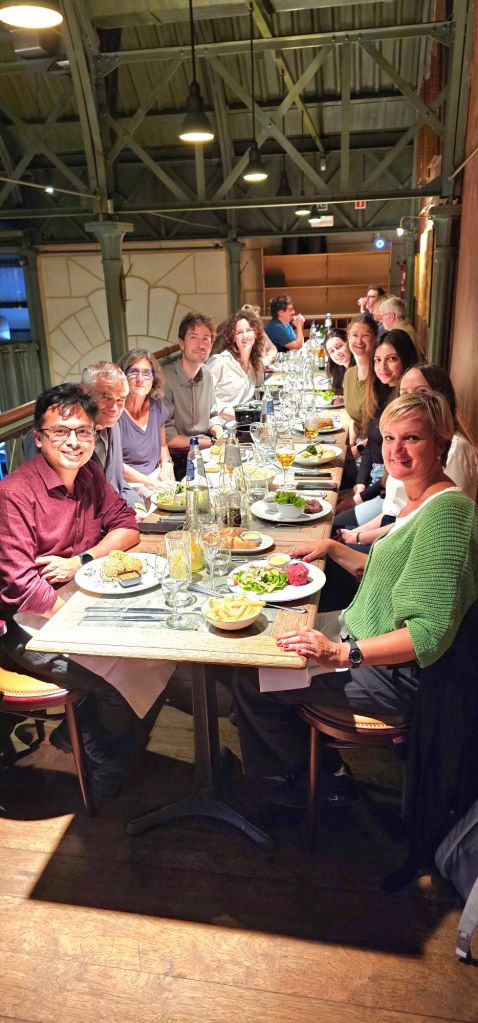
A short trip to Ghent made the trip even more special. We had a delightful boat ride along the city canals and spent an evening walking the center of the city before returning to Brussels by train. Dinner with the Ghent group was warm and collegial. Those informal conversations around the table were as valuable as any session for building scientific rapport.
Takeaways
ERRS 2025 was a fruitful meeting. The scientific sessions updated me on many ongoing developments in radiation science, from molecular mechanisms to population studies. Presenting our work and engaging in rigorous discussion was energizing. It was particularly valuable to compare notes with the Ghent team and to plan collaborative follow-ups.
I am grateful to all my lab members, funding agencies, and organisers of the ERRS 2025 meeting. I also feel thankful for the enriching interactions with mentors, colleagues, and new friends who made this trip both scientifically and personally rewarding. I share a few pictures below.
I also thank you very much for reading.
Take care and smile,
Prabodha









 Dr. Prabodha Kumar Meher