Runsten in Sweden – Interesting history of human art and emotional skill from Viking age

Runsten (English: Rune Stone) refers to typically a raised stone with a runic inscription, but the term can also be applied to inscriptions on boulders and on bedrock. The tradition began in the 4th century and lasted into the 12th century, but most of the runestones date from the late Viking Age [Runestone – Wikipedia ]. Runestones occur throughout the Nordic cultural area – Sweden, Norway and Denmark, as well as in some areas with Nordic influence. 

It is really interesting how humans in Nordic area used the inscription on stone to express their emotion such as love, respect and honour of exceptional , beloved persons in their lives. They used to make this in memory of there loved ones. And more interestingly, they raised this stone in the central place of the village or their community. In more than 90% of cases, the people who had stones were found dead. Every eighth stone was erected by a single woman, one in ten by a woman along with several men; often the widow and sons of the dead, but sometimes also sisters and brothers. Specially it is always made by a person for another person.  Like you give honour to another person.  There are about 3720 number of runsten found in Sweden alone and about 3000 more around other part of world (Mostly nordic countries). 

During my visit to different places near to Stockholm. I have seen several of these but I love this runsten ( U 1011 ) really interesting. It was carved by  Vigmund and Åfrid during 11th Century. It is now stands in the Uppsala University Park in central Uppsala in Uppland. It is unusual for someone to have carved a memorial during their lifetime over himself, as Vigmund has done here and boastfully tried to win God’s grace. In the text, he says that he has been a “ship chief” and the most skilled of men. The memorial is thus a “steering master stone” erected in honor of a mate, the ship’s commander.  Tentative translation as written on the runestone “Vigmund had the stone cut in memory of himself, the most skilled of men. God help the soul of the shipowner Vigmund. Vigmund and Åfrid cut the memorial while he was alive.”  [Uppland runic inscriptions 1011 – Wikipedia ]

Interesting is not it!! In a lighter sense, on a positive note, you may consider that . You need to praise yourself if no one else is doing. Self motivation as seen from 11th Century. I love this picture. Sharing below. If you ever visit Uppsala university do visit this at University park. There are many other runestones around. 

Thanks for reading. Have nice time. Now please smile 🙂 😊 or laugh loud if no one around!😁Cheers!

The runestone, I love, image credit Prof. Andrzej Wojcik
Description of the runestone U1011. Zoomed in! 

Meditation Explained by Nithya Shanti

Excellent post on Meditation by Nithya Shanti on his facebook page… You would love to read.. the link is
I reproduce the text without altering..
“Sometimes when you meditate
Sometimes when you meditate, you just can’t meditate. This is how meditation deepens humility, acceptance and perseverance.
Sometimes when you meditate for ten minutes, it feels like an hour. This is how meditation makes life longer.
Sometimes when you meditate for an hour, it feels like a few minutes. This is how meditation enables you to get through difficult times quickly.
Sometimes when you meditate, you drop all the pains of the past and worries about the future. This is how meditation liberates you from your stories and narrow sense of identity.
Sometimes when you meditate, you are full of questions and doubts. This is how meditation teaches you to let your questions breathe and know doubt as simply doubt – which is a return to clarity again.
Sometimes when you meditate, you get answers to your questions. This is how meditation awakens intuition and natural wisdom and fills you with the confidence to face life.
Sometimes when you meditate the body unexpectedly jerks or strange feelings surface. This is one of the ways meditation releases deeply held tensions, cellular memories, suppressed emotions and traumas. Restoring equilibrium.
Sometimes when you meditate the mind just won’t stop – there seems to be an endless parade of thoughts and impressions. This is how meditation strengths metacognition – the ability to be aware of thoughts without drowning or being completely swept away by them.
Sometimes when you meditate, you feel you wasted your time, as you were all over the place. Then later in the day you notice you are less reactive, more at ease, more mindful and you smile an inner smile of recognition – nothing was wasted after all.
Sometimes when you meditate, you completely lose track of time and space. This is how meditation makes you ageless and timeless.
Sometimes meditation continues after you have finished meditation. This is how your whole life becomes filled with the clarity and peace of meditation.
Sometimes when you meditate, nothing happens, the meditator disappears and everything just is as it is in simple perfection. This is the fruit of meditation – entirely tasteless, yet sublime and free.
Sometimes when you meditate separation vanishes. Everything is consciousness, awareness, reflecting itself in endless diversity. Waves are known to be no different from the ocean. All resistance dissolves. You see your faceless face. The game of deservability ends. You return to being a happy nobody.
~ Nithya Shanti”
Excellent..

How are you?

How many calls we make and receive to your family members, friends, or relatives per day? Do you remember? Nevermind, nobody counts it. Especially, when we have unlimited calls pack on your mobile. It is not noticed, but in general, when we make a call, we ask “How are you?” Likewise, when you receive a call, other people also ask  “How are you?”.


What is the answer you give or hear?

The most common answer is “I am fine”

How are you?
How are you? Dare

Good! But, the reason we are talking about this here is simple. The most common question in a telephonic conversation start with “How are you?”. And similarly, the most immediate distorted answer is “I am fine”.

This specific question and its answer have become symbolic now.  Most of the time, we don’t care what we are asking and also we give an answer to this question which is untrue! Don’t you think, it feels like we are robots, not humans. Why we can’t skip this question? Then, an immediate answer arises is “we are humans and nothing wrong in asking”. Similarly, there is nothing wrong with just saying “I am fine”.

Anyway, why it is happening? Is it a problem on our side or on the other side?

  1. We care for the person we are talking about, but the person answering feels that “you really do not care” whether he/she is good or not. 
  2. We pretend to care for the person we are talking about, but the person answering knows well that “you really do not care” whether he/she is good or not.
  3. We care for the person and the person on the other ends also knows you really care. But, still tries to fabricate his/her answer. There might be several reasons for giving a fabricating answer. 

It is always good to ask and to expect to hear everything is fine with the person we are talking with. But, we should be equally eager to know their actual condition. We should work more to build trust with the people around us. So, we/they can share the truth about being “good” or “not good”. We also need to be concern enough while asking “how are you?”. It is a long discussion topic. But, one thing that needs to be taken care of…

“We need to create a human vibe among us while talking.”

I know, it does not work everywhere and every situation. But, I wonder why not? If we, the human talking!

Opposition Party of India (OPI) – Politics

Hi, let’s talk little about politics and democracy today. Okay, if you are wondering… why we will discuss politics? Because let me bring a point for you. In a democratic system, politics form the Government and this government makes & decides on various policies in the country. These policies and their implementations lead the way in how a country will work and develop in various sectors.  So, it does not matter if you are a Farmer, Teacher, Student, Businessman, Doctor, Engineer, Clerk, Scientist, Artist, Sportsman, Police, Prisoner, or any other professional (even if you are jobless),  you are directly or indirectly dependent on government and its policies. So spending some time on politics and putting your own thoughts and ideas will never harm you… right!😝
OK!
So, apart from the term “Government”, we also hear another term i.e. “Opposition” or “Opposition party”. Yes, they are the party (es) or group of the elected representatives of people. In simple meaning, this party stands opposite to the Government. They ask questions and criticizes the policies of the government. Well, does this mean, they are the problem creator for the Government? Do they restrict the progress and development of a country?  The general answer is “NO!”. In fact, it is said, in a healthy democracy a strong opposition is always needed. It prevents the probable monopoly rule (viz. King’s rule) by the government.  The questions and criticism of the opposition party help the government to think and evaluate its policies carefully and implement in such a way that it should be effective and deliver 100%. If I am not wrong, a party needs just more than half of the seats to form a government but the ruling government party needs generally two-third of the support to implement a new policy or modifying an existing one. Thus, in one way, the role of the opposition in a democracy is equally pivotal like a government forming party.  
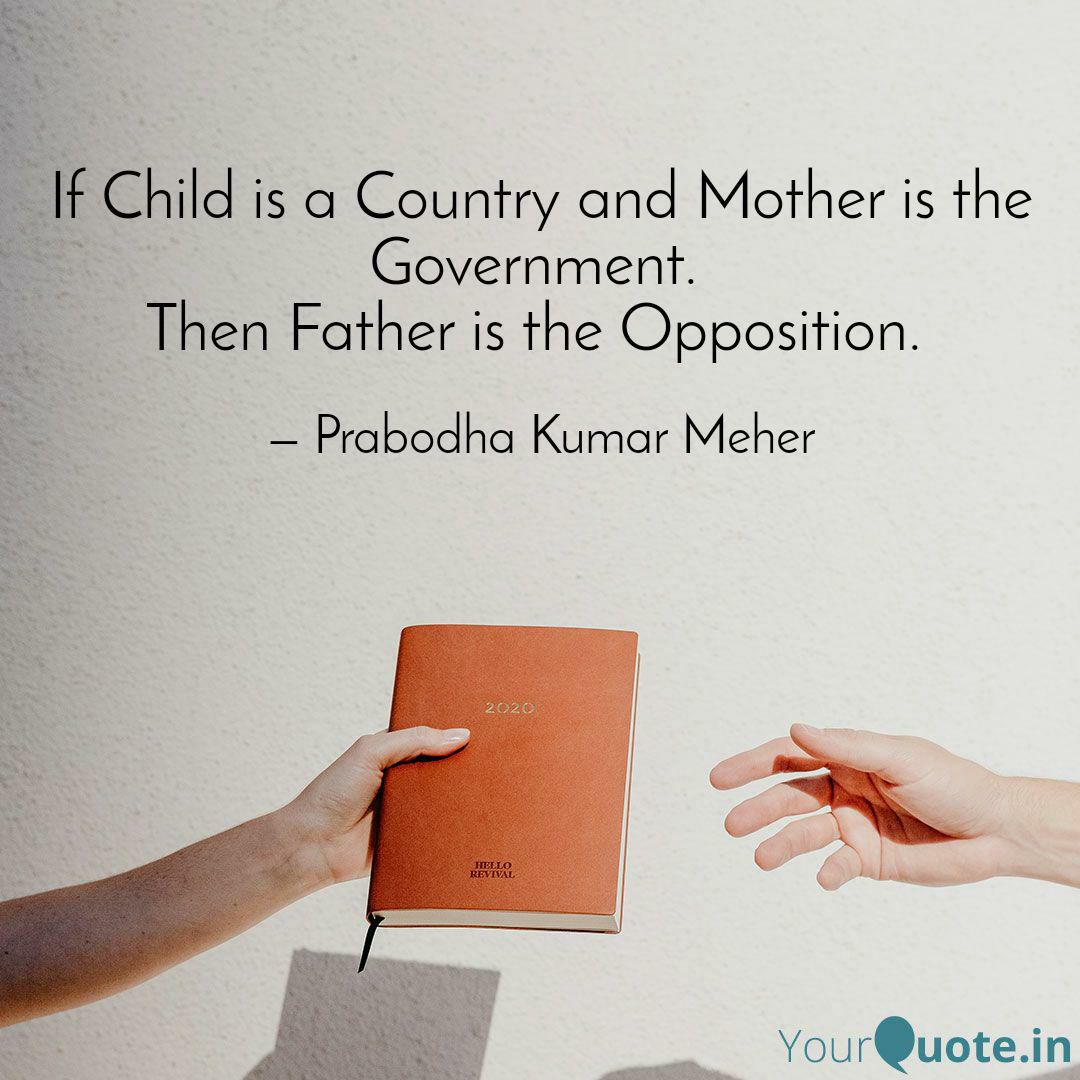
So, we can say “If Child is a Country and Mother is the Government. Then Father is the Opposition. Then, why we do not have a “political party” who is only to play the role of a father in the development of a Child called India? Why it is always evident that every political party wants to become a ruler or form government? Why till now, not a single party come out with a moto to play the role of opposition since the beginning of every election? 

The Country, The Government & The Opposition 

Perhaps, I am and maybe you are wrong. Perhaps, every party thinks they can only perform, only if they come to power. And the role of opposition if they get, was an unwanted or forceful one. Or maybe in another way,  “It is not always the only moto of a party to make India progress or developed”. It seems there are a lot of things which I and you (common people) are unaware of the role of Government, Opposition & development of a nation.

Therefore, what are your opinions on the following thoughts…

1. Though, “A STABLE government is key for national development”. Statements like “A STABLE opposition is also equally important for the progress of a nation!” Stands nowhere?

2. What you think? Can we see a political party in future who can reach to people and say firmly “We are the Opposition Party of India, we will not form the government but will play side by side with the government to help the development of our country”. It seems illogical right?? 

Nevermind, we are not professional to discuss politics. And also, spending some time on politics and putting your own thoughts and ideas will never harm us.😜😜
Thanks for reading. Please, don’t forget to write some crazy, out of box, awesome, excellent, poor, unimaginable comment below. Everything is precious rather than going out and make the Corona pandemic more severe.  #StayHomeStaySafe, and Stay Healthy.
Cheers,
Prabodha

On-line Applications Process and Digital India

Gone are the days, when we used to take photocopy of an application form (or format), fill it with a pen, attach a printed photograph, enclose it in an envelop with required documents and send it by post… when we want to apply for a vacancy in Government/Private job in India. Now, things are much better, easier, relatively cheap and reliably fast. All credits to vast use of Computer and Internet. But the Digital India movement by Government of India need special credit for this development. Almost all or at least 50-70% of any recruitment process in India now involves digital platform. These process are not only centered around the Computers, rather it has become so easy that one can do everything using the mobile phones. This all we know and enjoy being part of this digital India movement directly or indirectly. However, out of uncountable vacancies and recruitment process occuring everyday in India, I wish to discuss here the online application process for teaching and/or non-teaching posts in academic institutions in India.

Okeyyy!  
By now, there might be couple of questions in your mind such as… 
What is the need of discussion on the recruitment process? Are the process followed by institutions not OK? Are you going to discuss about conventional merits/demerits of digital India movements?? And many more… So, to keep things clear and simple, I am not going to discuss any of these questions/topics. These questions might be of equal importance for discussion. But, I want to share my thoughts on moving one step a head on online application process in india and how to mak the process more efficient and easier. 
So let’s discuss with an example here… 
Assume, you saw an advertisement for a teaching position (e.g. Sub.- English; Position- Assistant Professor) in a University-A , you can easily fill all details as asked in each step of online application form, then verify, even you can pay the application fee and submit online sitting anywhere. Fine! Great! 
Now just think, you saw another advertisement for same teaching position (e.g. Sub.- English; Position- Assistant Professor) in another University-B. There is 90% chance that University-B  asking you to fill same things in their online application, because qualification for same subject and same rank is same in every institution (as per University Grants Commission, UGC norms). 
So, if you wish to apply here in University-B too. You need to give all details again, fill the forms again and more than 90% possibility that you will encounter a different application format from the previous application you filled for University-A. Think about the time and effort you are giving to fill-up application for University-B. Now imagine all the time and effort it will take from you if you want to apply for more than 5 or 10 Universities!!! 
You will become a data entry expert or clerk for sure 😃. And this is not something that you want in a digital world?? Seriously, not at least in digitalized India!! Then, what is the solution?
Yes! We/Ministry of HRD , Government of India/ UGC need to find a way to overcome this difficulty and use the best of digitalization/ technology.  
What can be done (Raw idea):
1. Why can’t government take an initiative for making a standard recruitment  platform for teaching positions and ask the applicants to fill and store his/her every essential details in a standard format. (Just like the way LinkedIn, ResearchGate , Academia.edu …etc user profile). Applicant can update and edit any time.
2. This platform does not necessarily be to public, it can be well protected by government (like digiLocker, Permanent Account Number Data, Driving License Data… etc) 
3. Each applicant can be assigned with a user-name or a registered number. The applicant can directly share this & pay the application fee while applying for any position.
4. After successful submission of application fees with username or registered number, University authority can retrieve all the required information of the applicant from the government server.
5. This will make the application process much efficient regardless of the number of vacancy/number of University an applicant wish to apply. 
This is a raw idea and can be improvised with further discussion. It is indeed, serious time consuming affair when you apply for a position in different Indian Universities/Institutions. Have you ever experienced this kind of problem?? Please don’t forget to share your thoughts in comment section. And share this to your colleagues and friend who you think can give some more inputs. 
Thank you very much for your time and reading! 
Cheers!
Prabodha
Acknowledgement: Dr. Aashish Soni Sir for his valuable  views and support. 
© Copyright: Dr. Prabodha Kumar Meher, 01, February 2020.